September in South Florida does not feel like autumn elsewhere. Heat builds through the morning, the sky darkens fast, and afternoon thunderstorms dump heavy rain on Miami-Dade, Broward, and the rest of the metro corridor. Drivers on the Turnpike, I-95, US-1, and neighborhood streets can go from clear pavement to standing water in minutes. Lopez Law, based in Coral Gables, shares this as practical personal-injury education — not a scare piece and not a promise about any case.
How September rain shows up on South Florida roads
Local weather patterns often mean brief but intense downpours. Water pools on flat asphalt, at underpasses, and where drains clog. Palm-lined streets and low-lying neighborhoods can look like shallow canals after one strong cell. Visibility drops. Tire contact with the road shrinks. That mix — sudden rain, standing water, and busy traffic — is what makes wet-road driving a regular September concern from Coral Gables to Kendall, Brickell, Hialeah, and north into Broward.
Tips to help prevent wet-road crashes
Watch for hydroplaning — and know how to recover if you lose control. When water lifts the tire off the pavement, steering and braking can feel light or useless for a moment. Slow down before the puddle, not in the middle of it. If the car starts to float or drift:
- Ease off the gas — do not floor it hoping to “power through.”
- Do not slam the brakes. Hard braking on a water film can lock a tire or throw the car sideways.
- Steer gently toward the direction you want to go. Keep both hands on the wheel and make small corrections.
- Do not overcorrect. A sharp yank the other way often causes a second skid once the tires grab again.
- When the tires bite and you have control, pull over somewhere safe and legal if you need a moment — a parking lot or a well-lit shoulder — before rejoining traffic.
Prevention still comes first: lower speed in standing water, avoid sudden lane changes through spray, and leave extra room for trucks that throw sheets of water across your windshield.
Increase following distance. Dry-road following habits leave too little room when roads are slick. Give the vehicle ahead more space so there is time to react if brake lights appear in a wall of rain.
Use headlights and protect visibility. Turn headlights on in rain so other drivers can see you — and so you can see lane lines, motorcycles, and pedestrians at the edge of the spray. Keep windshield wipers in good shape; replace blades that streak. If the rain is so heavy that the wipers cannot keep up, that is a cue to slow further or leave the travel lane safely when possible.
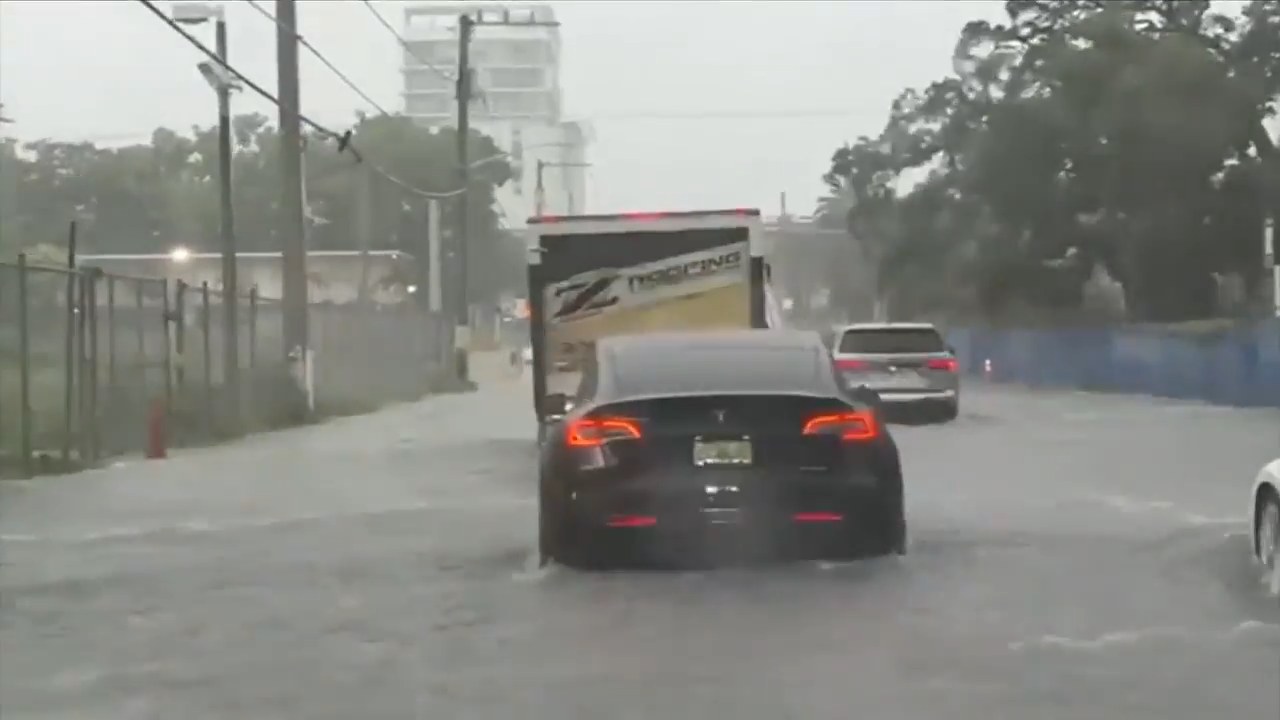
Respect flooded streets — turn around, don’t drown. Never drive into water when you cannot see the pavement or the bottom of the tire. A flooded underpass or neighborhood dip can stall an engine, float a light vehicle, or hide a washed-out shoulder. If water is rising across the road, turn around and take another route. Local news stills from recent South Florida storms show cars mid-axle in standing water on ordinary city streets — that is not the place to “push through.”
Know when to pull over. If lightning is close, hail starts, or spray from trucks blanks out the windshield, look for a safe place off the travel lanes — a parking lot, a well-lit shoulder where stopping is legal and visible, not a blind curve. Hazard lights help others see a stopped vehicle. Waiting out the heaviest cell is often safer than forcing the next mile.
If a crash happens on a wet South Florida road
Safety comes first. Check for injuries, move out of live traffic if the vehicles can be moved safely, and call 911 when anyone is hurt or the scene is blocking the roadway. Photograph the scene when it is safe: road wetness, standing water, skid marks if any, vehicle positions, weather conditions, and nearby signs or signals. Exchange information, but do not argue fault at the roadside and do not admit fault. Wet roads complicate how insurers and other parties describe speed, following distance, and control — statements given in the moment can get repeated later in ways that are hard to walk back.
Talk with counsel before signing releases or settling with an insurer. Early settlement pressure is common after any crash; rain-related crashes are no exception. An attorney can help review medical documentation, the police report, and how coverage may apply under Florida law. Lopez Law educates the community on these steps so drivers know what to protect — the firm does not use this post to decide anyone’s claim.
Thoughts are with everyone who has to drive through a South Florida downpour this September.
Lopez Law, Coral Gables. Call 305-605-6739.
This is not legal advice.
Lopez Law2151 S Le Jeune Rd, Suite 305
Coral Gables, FL 33134
305-605-6739
Photo credit: WSVN 7News, September 2025 South Florida flood coverage.
See also Miami car accidents.